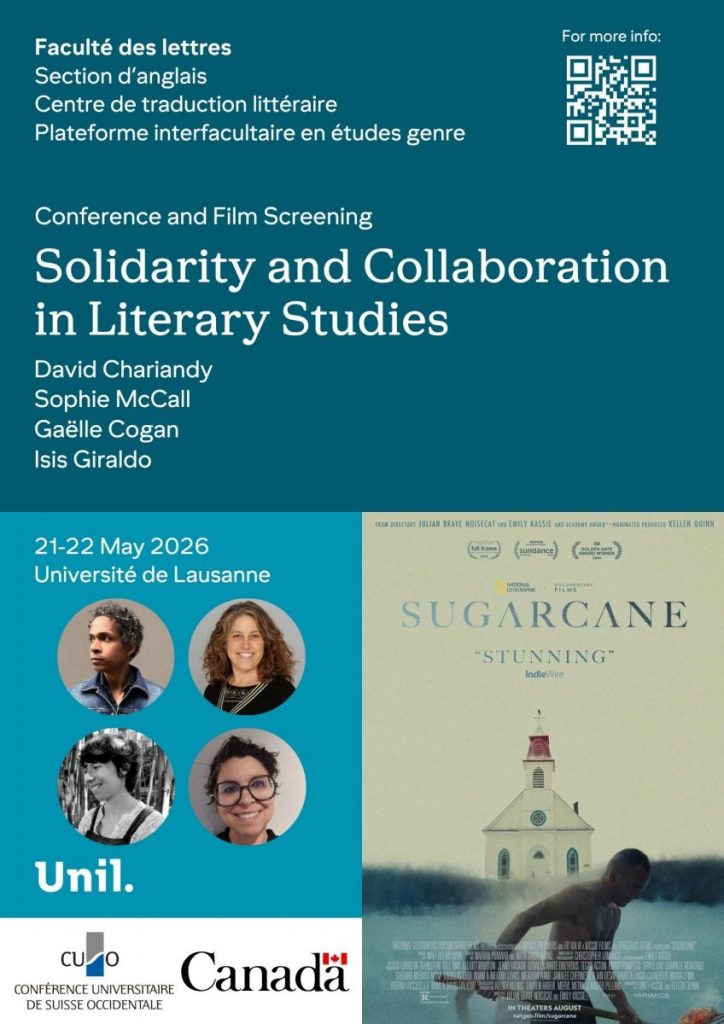
An event organized by Dr. Patrizia Zanella and Dr. Matthew Scully in collaboration with CUSO (Conférence universitaire de Suisse occidentale), the Department of English at the University of Lausanne, the Centre de traduction littéraire de Lausanne (UNIL), Plateforme interfacultaire en études genre (PlaGe), and the Embassy of Canada in Switzerland.
Description: This 2-day CUSO workshop and public conference will give doctoral students and others across Switzerland the opportunity to discuss and reflect on modes of solidarity and collaboration within the context of literary studies. We will consider Indigenous Studies and Black Studies as particularly generative foundations for these conversations due to the ethical weight they give to solidarity and collaboration, but such topics appeal to a wide variety of other fields and subfields important to Swiss doctoral students working in Anglophone literary studies, including American Literary Studies, Decolonial Theory, Gender and Sexuality Studies, and Translation Studies, to name a few fields for which collaboration is itself an ethos. Our invited speakers, David Chariandy, Sophie McCall, Isis Giraldo, and Gaëlle Cogan combine academic and literary expertise and experience, so they will be an excellent set of interlocutors for these discussions. This event also aims to address practical considerations, such as how to collaborate ethically and effectively in a variety of contexts. We will also include a literary translator to offer further insight on the collaborative nature of translation (for the workshop on translation). The event concludes on Friday with a public film screening of Sugarcane and apéro organized in collaboration with the Embassy of Canada in Switzerland. The trailer of the documentary Sugarcane can be viewed here. Throughout the workshop, we will be especially attentive to modes of solidarity with and through differences (following the work of Audre Lorde and others), rather than forms of being and working together that risk erasing difference into sameness.
If you’d like to participate in the conference, you can register with CUSO or email matthew.scully@unil.ch.
The film screening is free and open to the public, but please register here.
For those unfamiliar with UNIL, the campus map can be found here.
Thursday, 21 May 2026 (Synathlon 2218):
- 12h30-14h00: Roundtable on Solidarity & Pedagogy with David Chariandy, Sophie McCall, and Isis Giraldo
- 14h-15h00: Workshop with Invited Speakers
- 15h-15h30: Coffee & Tea
- 15h30-17h: Doctoral Workshop I
- Elodie Rogliardo (UNIGE)
- Aybüke Karabiyik (Radboud)
- 17h-18h: Apéro
- 18h-19h30: Public Literary Reading and Discussion with David Chariandy and Sophie McCall
- Book signing with David Chariandy; books supplied by Books Books Books
- Dinner
Friday, 22 May 2026 (Villanova):
- 9h-9h30: Coffee & Tea
- 9h30h-10h30: Doctoral Workshop II
- Sabrina Sampaio (UNIGE)
- Britta Brügger (UNIBE)
- 10h30-12h00: Roundtable on Translation & Collaboration with Gaëlle Cogan, David Chariandy, and Sophie McCall
- 12h30-14h: Lunch & Closing Discussion
Public Film Screening and Apéro, organized in collaboration with the Embassy of Canada in Switzerland
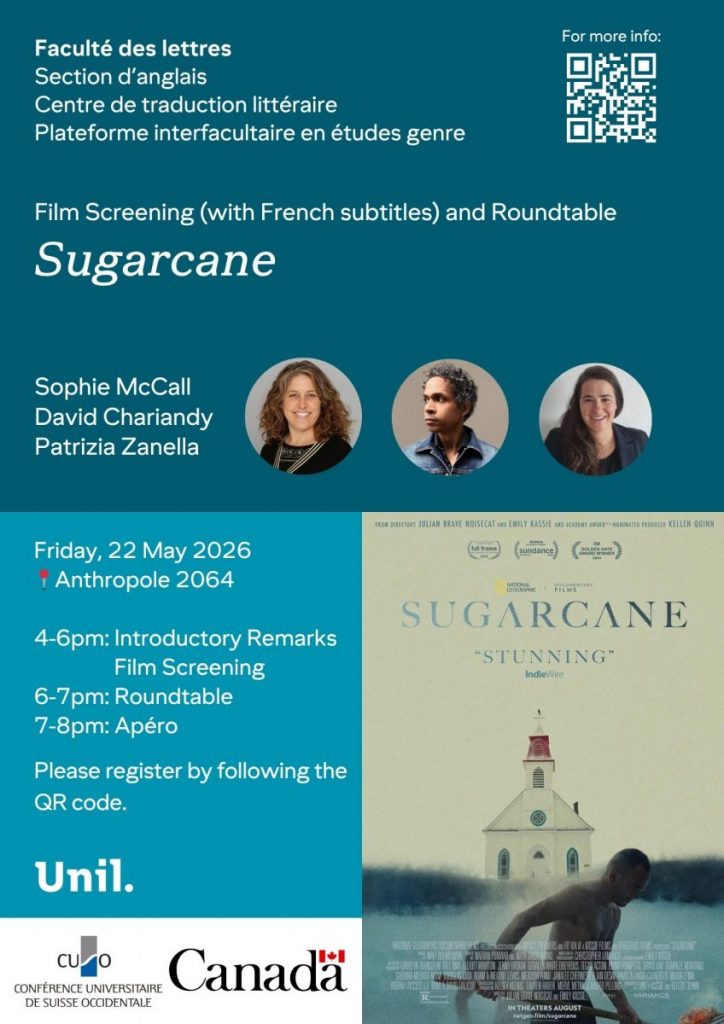
The film screening is free and open to the public, but please register here.
Anthropole 2064:
- 16h-18h: Film Screening of Sugarcane
- Introductory Remarks
- Film Screening
- 18h-19h: Roundtable with David Chariandy, Sophie McCall, and Patrizia Zanella
- 19h-20h: Apéro & Book Sale by Books Books Books
Our Speakers
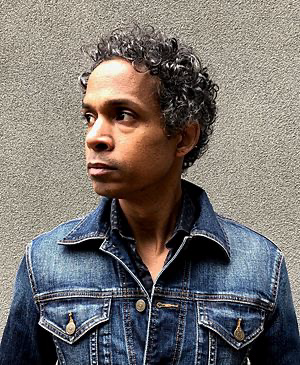
David Chariandy (he/him) is creative writer, scholar of Black and Canadian literatures, and Interim director of Caribbean Studies at the University of Toronto. Author of the novels Soucouyant and Brother, and the epistolary memoir I’ve Been Meaning To Tell You: A Letter To My Daughter, his books have been widely discussed, translated into a dozen languages, and awarded the Rogers Writers’ Trust Fiction Prize, the Toronto Book Prize, the Ethel Wilson Fiction Prize, and the Windham-Campbell Prize for Fiction. As a critic, he has contributed substantially to the field of Black Canadian literature through articles, book chapters, publishing initiatives, and co-edited special issues of journals. He is a member of the editorial board of Brick: A literary journal and a fellow of the Royal Society of Canada, Division of Arts. Professor Chariandy’s goals are to support creative writing, to organize cultural events bridging the public/academic divide, and to deepen space for the study of Black, Caribbean, and Canadian literatures. A specialist in prose forms, his recent writing projects confront auto-theory, ‘critical fabulation,’ and disjunction in diasporic narration. Having served on executive, steering, or advisory committees for the Writer’s Union of Canada, the Canada Council for the Arts, the Vancouver Public Library, the Public Lending Right Program, Broadview Press, and McClelland & Stewart Press, he remains multiply engaged in the rapidly shifting ecology of writing, publishing, and reading in Canada.
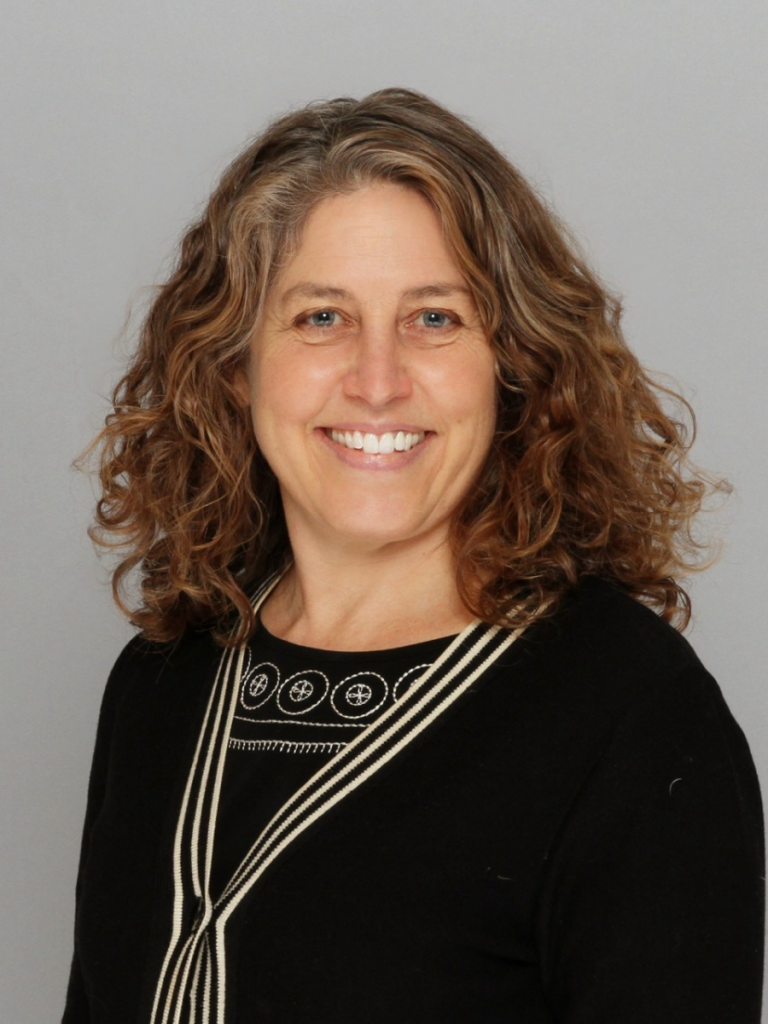
Sophie McCall has been writing and thinking about collaboration for a long time but still has many questions about what it’s all about. She is a Scottish-descended settler scholar, forever learning and un-learning how to read, listen to, and engage with Indigenous stories. She feels fortunate to have participated in collaborative projects with Indigenous scholars, writers, and artists over the past many years—from co-writing, to co-editing, to working collectively to bring about much-needed institutional change at the university. She learned a lot from a series of workshops held by Warren Cariou in the 2010s in Winnipeg in developing the series, First Voices, First Texts, which aimed to reconnect communities with Indigenous texts that had gone out of print, and subsequently working with the family members of Mohawk writer and animal rights activist, Anahareo, in preparing a new edition of her life narrative, Devil in Deerskins (U Manitoba P 2014). She has written about collaboration in her book, First Person Plural: Aboriginal Storytelling and the Ethics of Collaboration (UBC P 2011), and with Métis artist Gabrielle L’Hirondelle Hill in the co-edited collection, The Land We Are: Artists and Writers Unsettle the Politics of Reconciliation (ARP Books 2015). With L’Hirondelle Hill, Cree-Métis scholar Deanna Reder, and settler scholar David Gaertner, she co-edited Read, Listen, Tell: Stories from Turtle Island (Wilfrid Laurier UP 2017). With Reder since 2017, she is the co-chair of the Indigenous Voices Awards (IVAs).
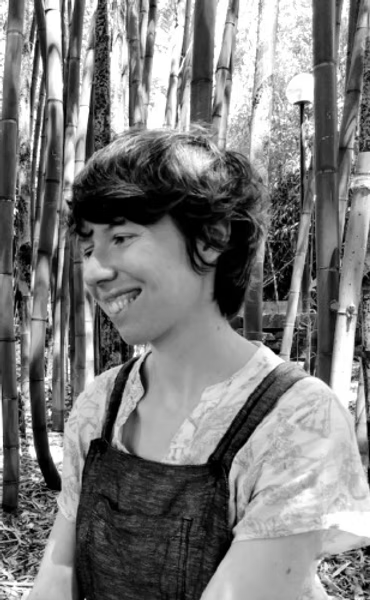
Gaëlle Cogan is a professional translator working across French and English and currently living in Switzerland. She has received a degree in American literature from the ENS in Paris and a degree in literary translation from the ETL in Paris. She translates fiction, essays, and poetry from English to French. She is also a member of the Association of Literary Translators of France.
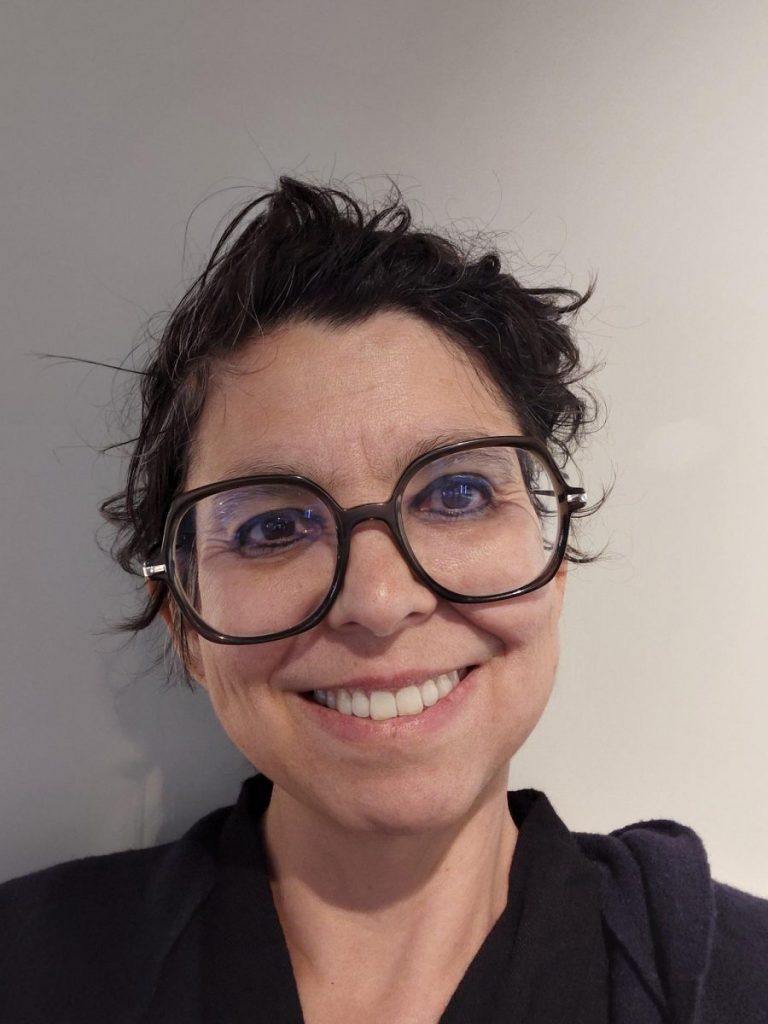
Isis Giraldo (MPhil, Oxford; PhD, Lausanne) is junior lecturer at the English Department of the University of Lausanne, where she teaches US literature and culture. Based on a conceptual framework that joins British cultural studies, New American studies, feminist theories, and Latin American decolonial critique, her work explores the connections between culture and power, asking questions on how regimes of race, gender, sexuality, coloniality, and political economy sediment through culture into common sense. Her work has appeared in various international journals, and her first monograph – Regimes of Colombianidad: beauty, citizenship, sex (SUNY Press) – is scheduled for publication in August 2026.