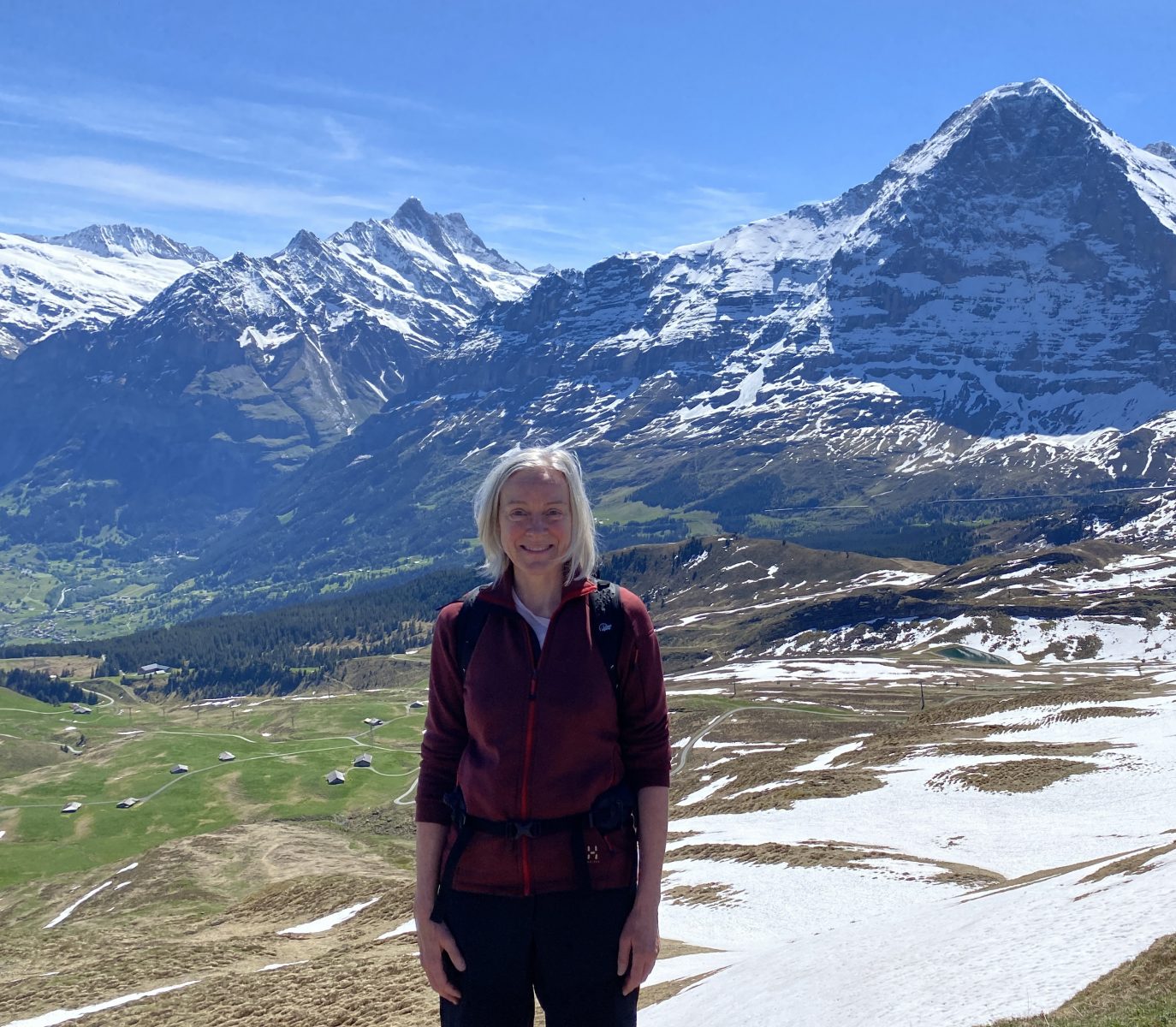
Hello and welcome. I am Professor of Modern English Literature at the University of Lausanne. My background is trans-Atlantic: born in Oxford, I’ve lived in Toronto, New York, and South Yorkshire. After two years teaching at the Charles University in Prague, I became a lecturer at Sheffield University, in the UK’s beautiful Peak District. In 2010, I took up my current position at the University of Lausanne. ‘By the waters of Léman’ is an inspiring place to teach English Literature, since it is associated in various ways with Mary Shelley’s Frankenstein, Byron’s The Prisoner of Chillon, P. B. Shelley’s Mont Blanc, T. S. Eliot’s The Waste Land, Fitzgerald’sTender is the Night, Joseph Conrad’s Under Western Eyes, Nabokov’s Pale Fire, Muriel Spark’s Finishing School, John Le Carré’s The Constant Gardener, and Robert MacFarlane’s Mountains of the Mind. The photo above was taken on the flanks of the Eiger, where J.R.R. Tolkien trekked in 1911. The Swiss mountains inspired his writing about Rivendell, Caradhras and much more.
My main area of expertise is the literary tradition of katabasis, or the descent to the underworld, such as we find in Gilgamesh, Homer, Virgil, Dante, and in our times, Primo Levi, Salman Rushdie, Margaret Atwood, Philip Pullman, Ursula LeGuin and many modern and contemporary writers. Katabasis often occurs in epic narratives, which I’ve loved since an early immersion in The Lord of the Rings, which led me on to Virgil and thence to Milton’s Paradise Lost, and that road goes ever on and on. I am also particularly interested in the work of 21C poets Seamus Heaney and Kathleen Jamie, as well as a range of poets from Simon Armitage and the Hot Poets, to Alice Oswald and Pascale Petit who are all re-imagining the possibilities of human-nature dialogue. The most important challenge we face in our times is how to live sustainably with other forms of life on the earth. As a scholar in the humanities, part of my response to the environmental crisis consists of reading, teaching and writing about our changing relationship to the natural world.